Antenna Placement in Mesh Systems
For optimal performance, the antenna should be positioned as far from the bottom of the device as possible.
Reasoning (technical):
- The ground (earth or large metal surfaces) acts as a lossy absorber and reflector for RF energy.
- When an antenna is mounted close to the bottom, its radiation pattern is distorted: energy is absorbed by the ground and constructive/destructive interference (multipath) occurs.
- The ground plane effect reduces effective gain, especially at low angles, which are critical for reliable peer-to-peer links in a mesh.
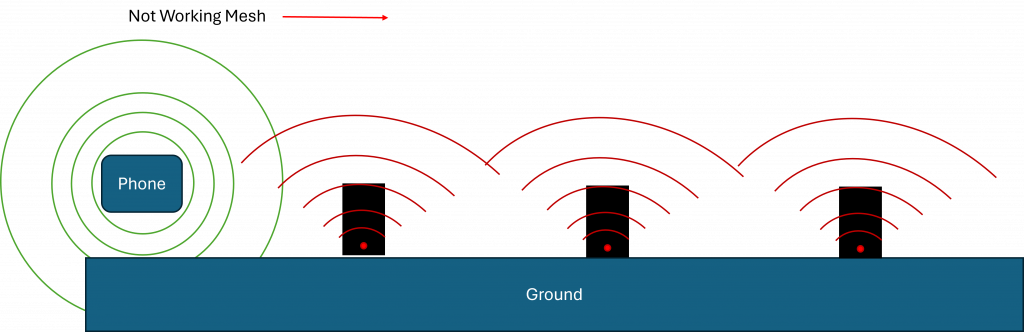
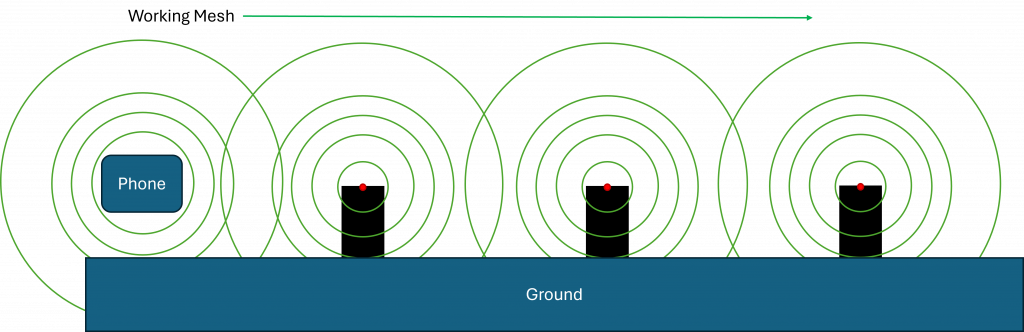
- A low antenna position increases shadowing, so nodes behind obstacles or at further distances can’t establish stable connections.
By keeping the antenna higher and away from the ground, the radiation lobes remain more symmetrical, coverage improves, and link quality (RSSI, SNR) stays consistent across the network.
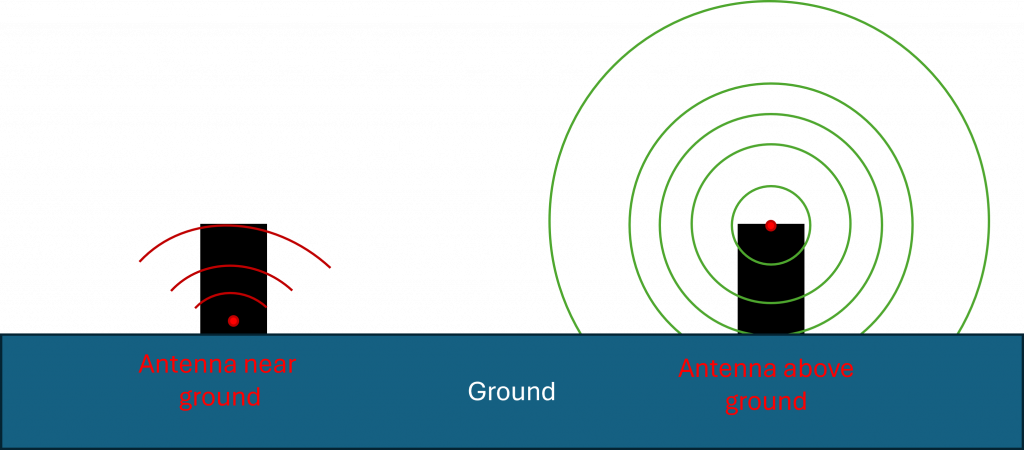
A common practice is to position the antenna beneath the front optics of the device.Because uplights standing on the ground faces upwards all the time.
Antenna Design
Keep-out & enclosure
- Provide a real keep-out volume around the antenna—no metal, ground, or high-εr plastics.
- Avoid metallized paint, carbon-loaded plastic, and water films in front of the antenna.
- If metal is unavoidable, use an on-metal type (PIFA/patch/slot) and treat the metal as the ground plane.
PCB & ground
- Follow the antenna datasheet keep-out exactly; no ground or traces under/around the radiator as specified.
- Solid ground elsewhere with via stitching; no splits under the RF feed.
- For monopoles, ensure adequate counterpoise (ground plane edge length ≳ λ/10) or add a tuned ground extension/sleeve.
Feed & matching
- 50 Ω controlled-impedance feed. Keep the RF path short; avoid stubs and right-angle bends.
- Place a π-network (shunt-series-shunt) at the feed for tuning in the final enclosure. Start with 0 Ω/NP and tune by measurement.
- Do not insert random ESD/EMI parts in the RF path; use RF-rated components only.
Cables & noise
Keep coax away from metal and avoid tight bends; strain-relief the connector.
Keep DC/DC converters, crystal cans, fast digital edges, and displays away from the antenna. Route noisy nets on internal layers; guard with ground vias.